
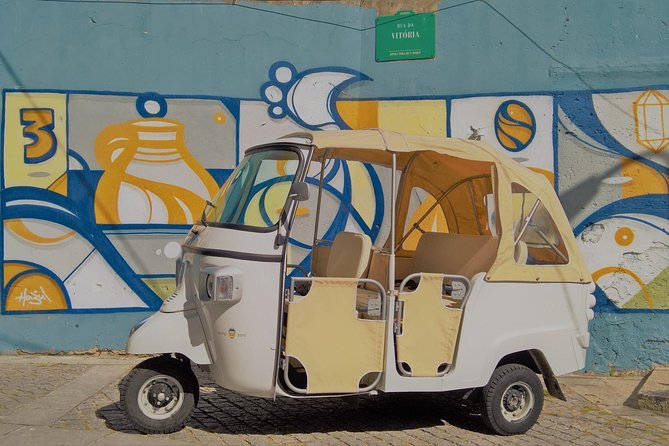
Reviewed · RIBEIRA & OLD TOWN
Porto Guided Tour to the Historical Center on a Tuk Tuk
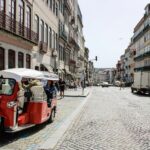
Porto’s historic center is best when you pace it right. This tuk tuk tour is built for fast orientation: you get rides between tight streets, short stop-and-see moments, and a classic taste of port along the way, all in about 2 hours. Porto by tuk tuk also means you’re not stuck doing a lot of stair-and-straight-line walking.
I especially like that the route mixes famous hits with the kind of places most people skip. And you’ll get port wine as part of the experience, not as an afterthought.
One possible drawback: the tuk tuk ride can be noisy, and if you’re seated farther back you might struggle to hear your guide during driving time. Bring a rain layer just in case, because weather can turn a quick plan into a wet one.
In This Review
- Key things to know before you go
- Why a tuk tuk makes sense in Porto’s historic lanes
- The early-1900s theater building and Porto’s fortified wall
- Cathedral, the pelourinho terrace, and the Episcopal Palace
- São Bento Station tiles: why this stop feels like a mini museum
- Praça Nova, the Blacksmith square story, and a lion fountain
- Rococo churches, Cordoaria Garden, and a planned view of Clérigos
- Palácio da Bolsa, D. Pedro’s statue, Livraria-style architecture, and the iron market
- Serra do Pilar viewpoint on the Gaia side and the two iconic bridges
- Price and time: is $42.33 good value for this route?
- How to make the tuk tuk experience work best for you
- Should you book the Porto guided historical center tuk tuk tour?
- FAQ
- How long is the Porto guided tuk tuk tour?
- What’s included in the tour price?
- Are monument tickets included?
- What language is the tour offered in?
- Does the tour require good weather?
- Is this a private tour?
- What’s the meeting point?
Key things to know before you go
- Short, timed stops: expect about 5 to 15 minutes per site so you can see a lot without feeling rushed nonstop.
- Tuk tuk access: this is one of the easier ways to reach tight lanes where normal cars don’t fit well.
- Port wine included: you’ll have a glass mid-tour, a fun Porto touch that helps the whole route feel special.
- Most entrances are extra: some major sights won’t be included, so plan for quick exterior looks unless you buy tickets.
- Views are a big part of the value: you’ll hit classic viewpoints, especially on the Gaia side.
- Timing can bend with traffic: local road conditions can affect when you arrive at each stop.
Deeper into Ribeira, its arcades and riverfront
- The Unvanquished Tour in Porto City Center★ 5.0 · 26,497 reviews
- Porto: The highest-rated traditional fado concert (downtown)★ 4.8 · 1,557 reviews
- Porto: Historical Center Walking Tour★ 4.8 · 898 reviews
- Historic Porto by Private Electric Tuk Tuk to Top Landmarks★ 4.5 · 735 reviews
Why a tuk tuk makes sense in Porto’s historic lanes
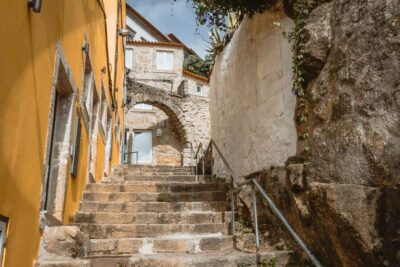
Porto’s center looks compact on a map, but in real life it’s a puzzle of slopes, narrow streets, and staircases. A tuk tuk route solves that. You sit back while the vehicle links the dots, and you use your limited time for the parts that really need your attention.
A big plus here is that you’re not just “driving around.” The schedule is built around getting out at the right moments for photos and quick understanding. Even if you’re only here for a day or two, the tour helps you see how the city is stacked—river, hills, and historic core all in one flow.
The early-1900s theater building and Porto’s fortified wall
The tour’s first city layers are about how Porto reinvented itself. You’ll start with a classic building constructed in 1910 on top of older ruins. The story matters: a major theater burned in 1908, then a new structure rose in its place, designed by Marques da Silva. You’ll notice the façade influences and the theatrical mission of the building—built not just to impress, but to stage performances and connect audiences to classic and contemporary drama.
Then you’ll be shown one of Porto’s more private secrets: the Muralha Fernandina, a medieval wall built between 1368 and 1437. What you’re really learning here is the logic of the city’s shape. When you see the wall trace and how it connects to older districts, you start to understand why streets bend the way they do. It’s the kind of stop that pays off later when you’re walking on your own.
Cathedral, the pelourinho terrace, and the Episcopal Palace
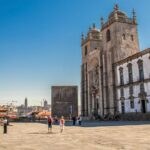
Next comes the religious heart of the historic center, with a Romanesque Catedral do Porto dating from the 12th or 13th century. The tour doesn’t only point at a building; it explains that it was enlarged and renewed over centuries, ending in a more “idealized medieval” setting after later work. That helps you read the cathedral as something lived-in and transformed, not frozen in one time period.
A short hop follows to the area connected to the pelourinho—a local government monument linked to the policy shifts of the Estado Novo era. In 1940, surrounding buildings tied to the cathedral and bishop’s area were demolished, then a paved terrace was created, and the monument was placed there in 1945 as a reproduction of an 1797 drawing. Even in a quick stop, it’s a reminder that Porto’s center has been reshaped by politics as much as by kings, merchants, and church leaders.
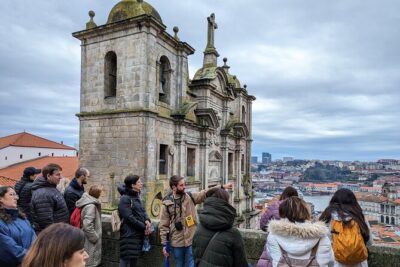
Then you’ll move to Paco Episcopal. You may see hints of a foundation older than the 13th century, plus a major remodel in 1737 attributed to Nicolau Nasoni (according to some accounts). The short time here works well because you can focus on façade details—the arch opening, pilasters, decorated fronton, and the bishop’s coat of arms.
São Bento Station tiles: why this stop feels like a mini museum
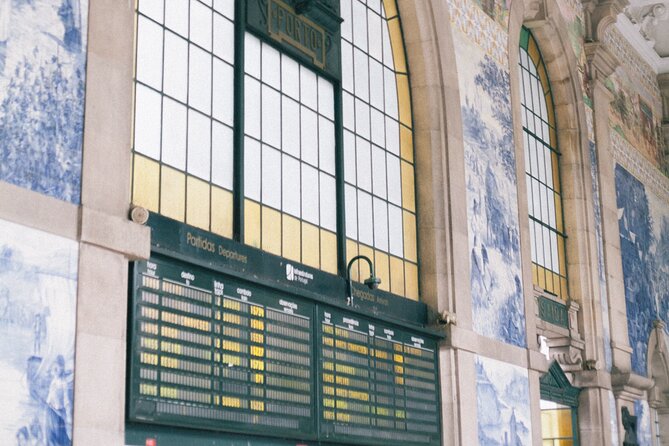
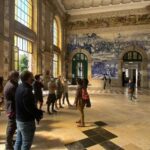
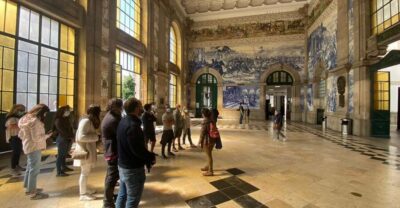
If you’ve seen photos of Porto, you’ve likely seen the azulejo tiles at São Bento Railway Station. This tour gives you a timed moment to appreciate why it’s famous: the station’s early-20th-century roof design (glass and cast iron) and the lobby covered with narrative tiles painted by Jorge Colaço.
You’ll come away thinking of São Bento as more than transportation. It’s art you can walk into without buying a ticket for the tiles themselves. And because this is a working station, it’s one of the more authentic “right-now” stops in the city center.
Buzz the hills by tuk-tuk instead


Praça Nova, the Blacksmith square story, and a lion fountain
Porto’s squares tell you who lived where and what work happened next door. You’ll spend time around the area where Praça Nova began in the early 1700s, when urbanization plans created new streets and a large square tied to the medieval walls.
This same zone carries the earlier identity of being called Praça dos Ferradores (Square of Blacksmiths). A palace—Palace of the Viscondes de Balsemão—went up on the east side, later used as a guesthouse, and it even hosted King Charles Alber of Sardinia during his exile in Porto. The current name connects to that period, so the square feels like a timeline.
You’ll also get the quick delight of the Fonte dos Leões (Fountain of the Lions), a 19th-century fountain built with French engineering input and cast in France. It’s a small stop, but the detail about it being based on a fountain in Leicester adds a fun layer: Porto was plugged into broader European design currents.
Rococo churches, Cordoaria Garden, and a planned view of Clérigos
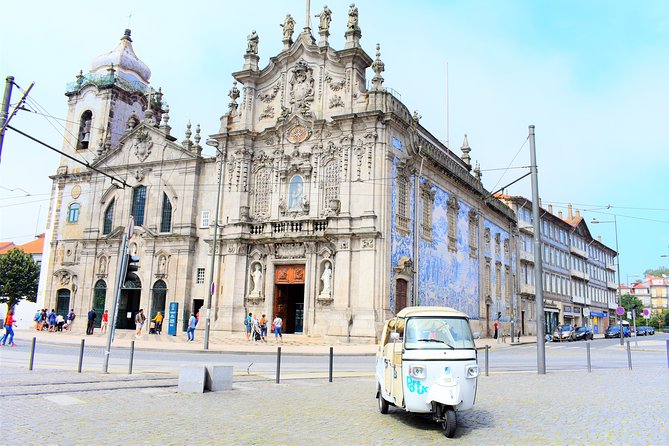
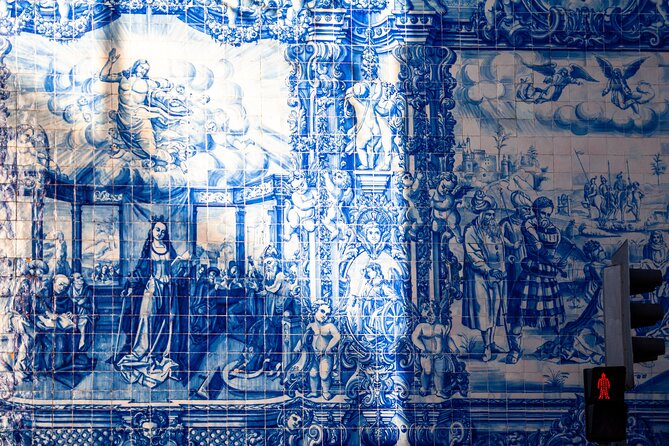
Porto’s baroque and rococo streak shows up in two major church-style stops here. One is a 17th-century church with a classical façade dating from the 1850s, and its Porto rococo-style altarpiece is described as stylistically revolutionary. Another is an 18th-century church known for interior carving and, importantly, a tiled side façade covered in 1912, with drawings linked to Silvestre Silvestri and themes related to the cult of Nossa Senhora.
These are short visits by design. That’s the trade-off with a tuk tuk route: you won’t stand there for an hour like you might on your own. The upside is that you’ll see the pattern—how Porto used ornate religious art to communicate power, devotion, and identity.
A calmer pause comes at Cordoaria Garden, also known as João Chagas Garden. The rope-makers link is the key detail: rope-making activity shaped the area for about 200 years, then the municipality transformed it into a public garden in the mid-1800s. Statues, sculptures, and the fact that it was remodeled as part of Porto 2001 make this stop feel like a living city space, not just a photo point.
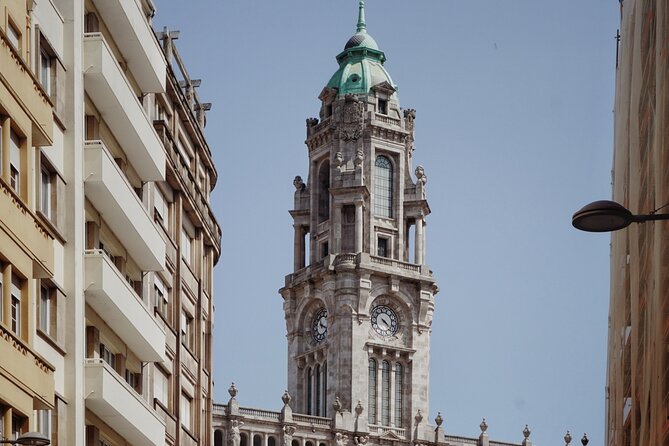
Then you’ll reach Torre dos Clérigos, the Baroque church and bell tower symbol you can spot from many parts of Porto. The value of this stop isn’t just the tower itself; it’s the way it anchors your sense of the city’s verticality—Porto is a city of views, and this tower helps you “orient upward.”
Palácio da Bolsa, D. Pedro’s statue, Livraria-style architecture, and the iron market
Later in the route, the tour leans toward Porto’s civic and commercial identity. You’ll visit Palácio da Bolsa, a National Monument and neoclassical building from 1842 tied to the Commercial Association of Porto. Its highlight is widely known as the Arabian Room, and even if you don’t go inside, the façade and setting help you connect the merchant world to the city’s historic center.
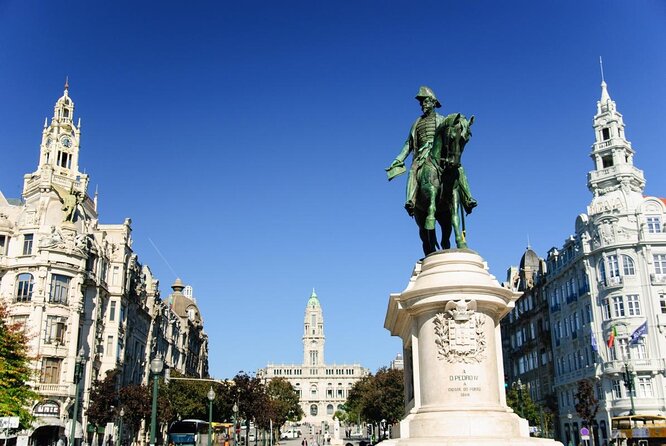
Nearby, you’ll see the Monument to the Infante D. Henrique area and other points that tie Porto to maritime pride and national identity. Another stop features a statue connected to D. Pedro, with a base that includes two sides describing the donation of his heart to Porto’s representatives and the arrival in Mindelo, plus a Belgian-cast figure showing D. Pedro offering the constitutional charter.
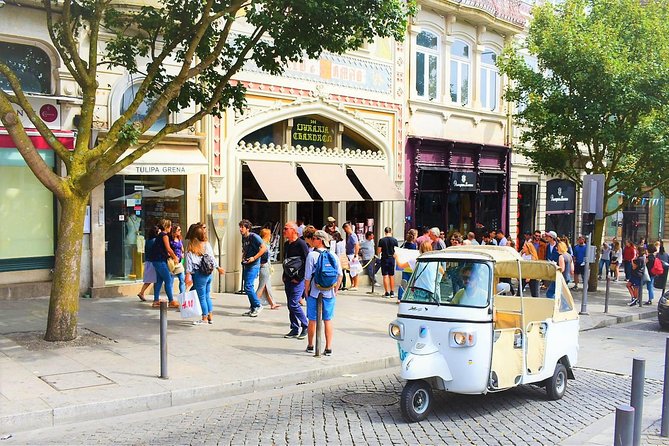
Then comes one of Porto’s most discussed interior landmarks: the building housing Livraria Lello. It was inaugurated in 1906 and is famous for its Art Nouveau façade with neo-Gothic details, plus a decorative interior with painted plaster wood effects and a striking staircase linking to the upper floor. There’s also a large stained-glass skylight bearing the monogram and motto Decus in Labore. The tour time gives you a look and context, but the building is the kind of place where you’ll be tempted to extend your visit later on your own.
You’ll also pass Mercado Ferreira Borges area and see how iron architecture became an entertainment venue, since the market built in 1885 was later renovated and now connects to Hard Club. Porto has an eye for reusing space, and this stop makes that visible.
Finally, the route includes Igreja de São Francisco, Porto’s major Gothic temple with a construction beginning in the 14th century, plus Baroque gilded interiors from the 17th and 18th centuries. Its Tree of Jesse and catacombs are called out as must-not-miss features. This is one of those “if you love details, plan extra time later” stops.
Serra do Pilar viewpoint on the Gaia side and the two iconic bridges
The tour’s most emotional payoff often comes when you get out on the Gaia side at Mosteiro da Serra do Pilar. Construction started in 1538 and finished around 1670, and the place has a layered past: Augustinian friars first, then during the Civil War of 1832–1834 the liberal army used it, followed by decades of disrepair. The restoration story matters because it explains why the monastery looks the way it does today.
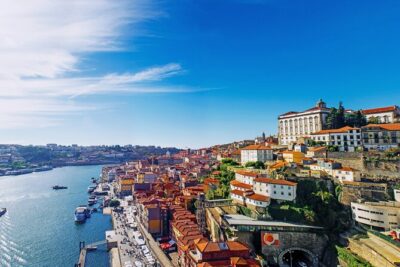
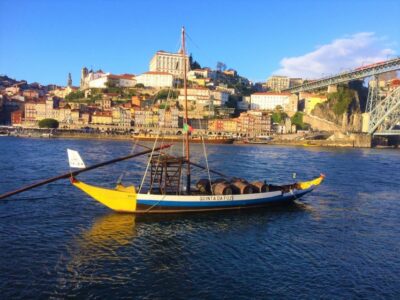
What you’re really there for is the terrace view. From up here, you can see the riverside area stretching toward Gaia, the historic center with the Cathedral and D. Luís I Bridge, and even Fontainhas and the São João bridge area in the opposite direction. It’s the kind of perspective that helps everything you saw inland finally click.
Then the route moves into bridge engineering and modern transit history. You’ll encounter D. Luís I Bridge: designed under Teófilo Seyrig (Eiffel’s disciple), inaugurated in 1886, and made of two overlapping iron decks. The key detail here is that the upper deck is tied to Porto’s Metro line, connecting the Cathedral area to viewpoints on the Gaia side.
After that, you’ll see the 2003 bridge built to replace the upper deck lane of D. Luís I for Metro use. It’s an arch bridge designed by engineer Adão da Fonseca, with a span and structural design described as elegant by experts of its type. Even if engineering isn’t your thing, this stop turns the bridges into living infrastructure, not just postcard monuments.
Price and time: is $42.33 good value for this route?
At $42.33 per person for about 1 hour 50 minutes, the value is mostly about coverage and transportation. You’re paying for a guide to move you between districts quickly and get you in front of major sights with minimal fuss. You’re also getting a glass of port wine and a driver/guide plus a local guide.
What you’re not paying for is monument entry. That’s a big deal if you’re hoping the tour includes full museum-style time inside every major stop. For many of the sites, you’ll get a fast look and explanation, then you can decide on your own whether you want to buy tickets.
This is one of the better “first day” formats because it teaches you how the city is organized. Once you understand which areas sit where, your later walking days become way easier. If you prefer slow, detailed museum time, you might feel the schedule is too tight—though you can always build a second day around only the stops that grabbed you.
How to make the tuk tuk experience work best for you
The best version of this tour is the one where you’re ready for short stops and you treat the ride itself as part of the learning. A few practical tips make a big difference.
- Sit where you can hear. If the driving is loud, try to be positioned closer to the guide so you can catch names and key facts.
- Plan for weather. On rainy days, you’ll want a raincoat and something to keep your feet comfortable.
- Use the stop windows smartly. When you get out, don’t spend the first two minutes taking out every photo-related item. Decide fast where your first photo and best angle are.
- If you want interiors, do it intentionally. Some stops are set up for exterior viewing and quick context. If a church or palace is a priority, be ready to return later and buy the ticket yourself.
- Expect traffic to change timing. Your last portion of the tour might be affected, so keep your next plan flexible.
Should you book the Porto guided historical center tuk tuk tour?
Book it if you want a fast, fun orientation around Porto’s historic core, especially if your legs need a break. The mix of historic walls, major religious buildings, tiled art at São Bento, a serious viewpoint at Serra do Pilar, and then the bridges gives you a sense of the city’s structure that walking alone can take longer to reveal.
Skip (or think carefully) if you hate tight schedules or you want long interior time at multiple monuments. Also consider that hearing the guide can be tricky during driving, so if you rely heavily on spoken commentary, sit close and be prepared to catch the highlights at the stops.
FAQ
How long is the Porto guided tuk tuk tour?
It runs for about 1 hour 50 minutes, with stop times varying by site and affected by local traffic.
What’s included in the tour price?
You’ll get a glass of port wine, the driver/guide, and local guide commentary. Monument entrances are not included.
Are monument tickets included?
No. Admission tickets for some monuments are not included, while a few stops note free admission.
What language is the tour offered in?
The tour is offered in English.
Does the tour require good weather?
Yes. This experience requires good weather, and if it’s canceled due to poor weather, you’ll be offered a different date or a full refund.
Is this a private tour?
Yes. It’s a private activity for your group only. Multiple tuk tuks are used for larger groups, but they keep the same stops at the same time.
What’s the meeting point?
The tour starts at R. de Augusto Rosa 180, 4000-528 Porto, Portugal, and ends back at the meeting point.
More Tour Reviews in Porto



Tuk-Tuk Runs Through the Hills

More of Ribeira and the Old Town


Fresh in the Porto notebook


Ribeira & Old Town, compared.
 ★ 5.0The Unvanquished Tour in Porto City CenterFrom $326,497 reviews
 ★ 4.8The highest-rated traditional fado concert (downtown)From $241,557 reviews
 ★ 4.7Historic City Center Walking TourFrom $331,172 reviews
 ★ 4.8Historical Center Walking TourFrom $41898 reviews
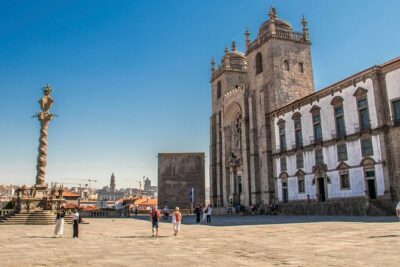 ★ 4.5Historic Porto by Private Electric Tuk Tuk to Top LandmarksFrom $42735 reviews
 ★ 4.9Tile Painting and Cocktails in Downtown PortoFrom $41484 reviews
 ★ 5.03-Hour Old Town & Riverside Bike Tour – Guided ExperienceFrom $47481 reviews
 ★ 5.0Pastel de Nata | Workshop from scratch | Porto’s city centerFrom $48449 reviews
Browse the lists this tour appears in