
Reviewed · PORTO TUK-TUK TOURS
Porto Half Day Private Tuk Tuk Tour
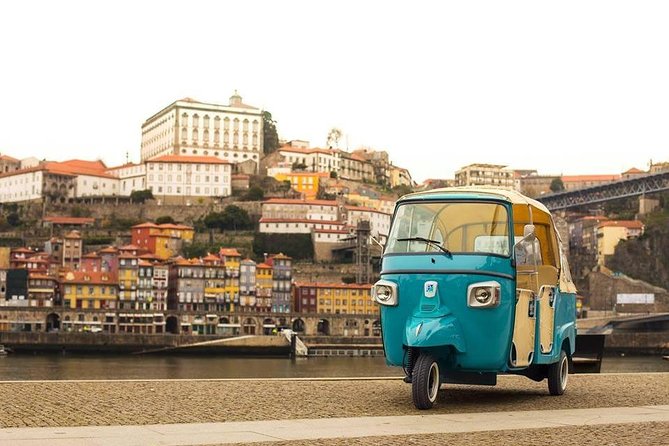
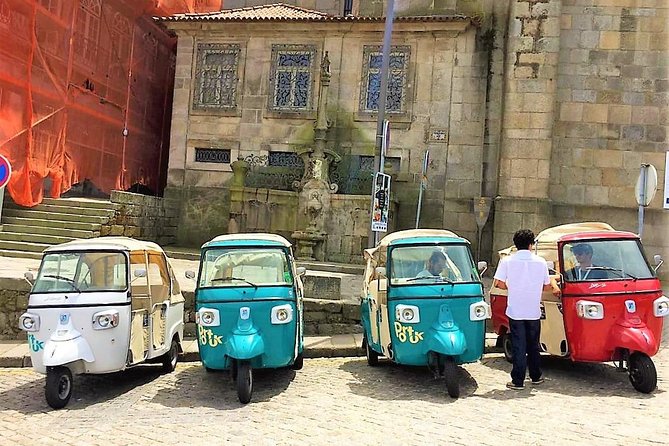
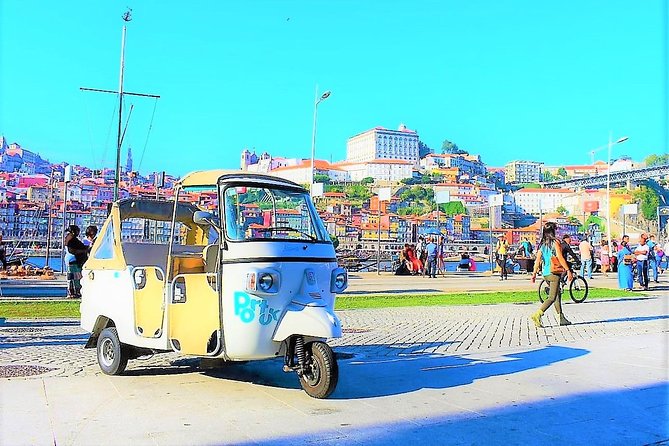
Porto reads better from a tuk-tuk. I like how the private guide provides live commentary as you move through Porto’s tight lanes, and I love that wine tasting is part of the half-day so you finish with a taste of the region, not just photos.
My main caution is timing and pacing. Traffic can slow things down, and if you’re unlucky, you may feel rushed or end earlier than expected—plus the tuk-tuk canopy can block the view on grey days.
In This Review
- Key highlights to look for
- Porto in 3.5 hours: why tuk-tuk beats a big tour bus
- Price and value: is $83.48 worth it?
- Meeting point and how the day typically flows
- The route: what each stop is really about (and what to do)
- Start near theatre history and a Romanesque boundary
- Serra do Pilar: the terrace view that sells Porto
- Dom Luís I bridge: Eiffel’s disciple and two iron decks
- Igreja de São Francisco: Gothic bones plus Baroque gold
- Palácio da Bolsa and the Arabian Room idea
- Praça near the Infante D. Henrique monument
- Jardins do Palácio de Cristal: the city’s “slow down” spell
- Mercado-to-entertainment: the iron architecture moment
- Alfândega Nova: museum building with two-faced design
- Igreja dos Carmelitas: a rococo altarpiece clue
- Cordoaria Garden (Jardim de João Chagas): ropes, statues, and 200 years
- Torre dos Clérigos and Igreja do Carmo: baroque height and azulejo detail
- Fonte dos Leões: a French water company’s copy
- Antiga Cadeia da Relação: prison geometry turned photo center
- Livraria Lello: Art Nouveau façade and the red-staircase vibe
- Guide quality is the real product: the best tours feel custom
- Who should book this Porto half-day tuk-tuk tour
- Should you book it?
- FAQ
- How long is the Porto half-day private tuk-tuk tour?
- How many people can ride in one tuk-tuk?
- Is the tour private?
- What language is the tour offered in?
- Is wine tasting included?
- Are tickets included for all attractions?
- Where does the tour start?
- What’s the weather rule?
Key highlights to look for
- Serra do Pilar terrace views over Porto, Vila Nova de Gaia, and the bridges
- Dom Luís I bridge from the perspective of two overlapping iron decks
- Church of Gold vibes at Igreja de São Francisco, with catacombs and gilded interior cues
- Palácio de Cristal gardens: fountains, sculptures, and the best “walk-a-little” viewpoints
- Livraria Lello and Clérigos area: quick hits where tickets may not be included
- Guide tailoring: ask what you care about, and the route can often shift
Buzz the hills by tuk-tuk instead
- Porto: Guided Tour by Tuk-Tuk & Optional Douro River Cruise★ 4.5 · 5,980 reviews
- Discover Porto’s Highlights on a 2-Hour Private Electric Tuk Tuk★ 4.5 · 1,860 reviews
- Porto: Guided Tuk Tuk Tour★ 4.6 · 1,390 reviews
- Historic Porto by Private Electric Tuk Tuk to Top Landmarks★ 4.5 · 735 reviews
Porto in 3.5 hours: why tuk-tuk beats a big tour bus
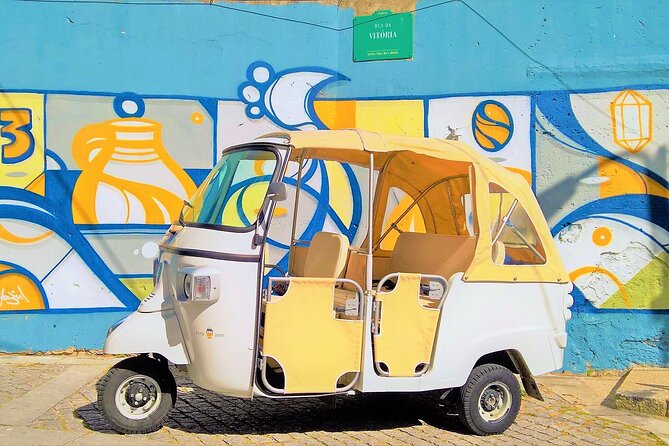
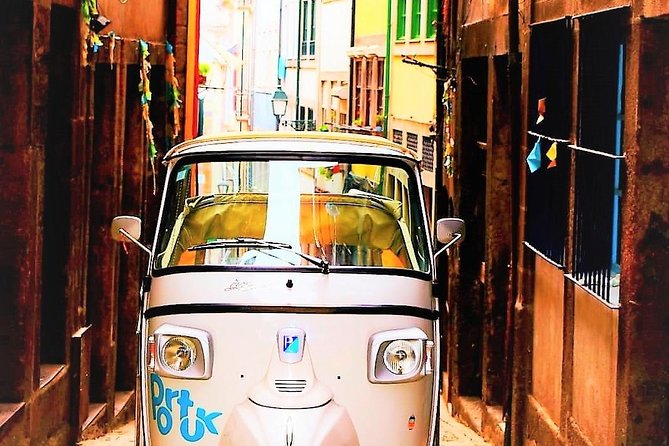
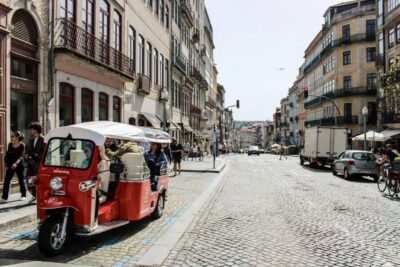
If your time in Porto is short, this is one of the better ways to get your bearings fast. Porto is hilly, streets can be narrow, and the city’s best moments tend to happen when you’re already in the right neighborhood. A tuk-tuk helps you do that without feeling like you’re constantly parking, walking long distances, and backtracking.
The “private” part matters too. Even though you’ll pass many of the same icons, the flow can shift based on your interests. In past tours, guides such as Ana, Gabi, Fabio, Bernardo, and Gonçalo have been singled out for adjusting stops and keeping the commentary focused on what you want to understand—architecture, neighborhoods, or just where to get a solid meal afterward.
One more thing: you’re not just “seeing sights.” You’re getting context while you’re still close enough to look up at details. That’s the difference between a photo stop and a real orientation.
Price and value: is $83.48 worth it?
At $83.48 per person for about 3 hours 30 minutes, you’re paying for three things: a guide, small-vehicle access, and included wine tasting.
A tuk-tuk isn’t the cheapest way to tour Porto, but it’s often good value because it can compress distance and effort. In practice, that means you spend more time looking at the city and less time figuring out transport logistics or climbing everywhere on foot. And because the guide is with you, you’re not left guessing what you’re looking at—especially with Porto’s mix of Gothic, Baroque, and neoclassical buildings stacked close together.
Wine tasting is the “region flavor” bonus. One of the complaints you might see is that wine tasting didn’t happen exactly as expected, so I’d treat the wine as included but ask your guide when it’s scheduled. If it’s a rainy day or traffic is heavy, timing can shift.
Bottom line: this feels worth it when you want a guided hit list plus a relaxed pace. If you prefer to wander and read every plaque yourself, a self-guided plan may be cheaper.
Meeting point and how the day typically flows
The tour starts and ends back at R. de Augusto Rosa 180, 4000-528 Porto. You’ll have a driver/guide and live commentary, and the experience is offered in English. You also get a mobile ticket, so you’re not juggling paper at the curb.
Expect a mix of short photo moments and a few slightly longer stops. Some places are quick looks from the vehicle or a brief walk-out; others give you time to stand, scan, and take in the view. That structure is key for Porto: you’ll cover more ground than you could on foot, but you’ll still have enough time at the best viewpoints to understand why they’re famous.
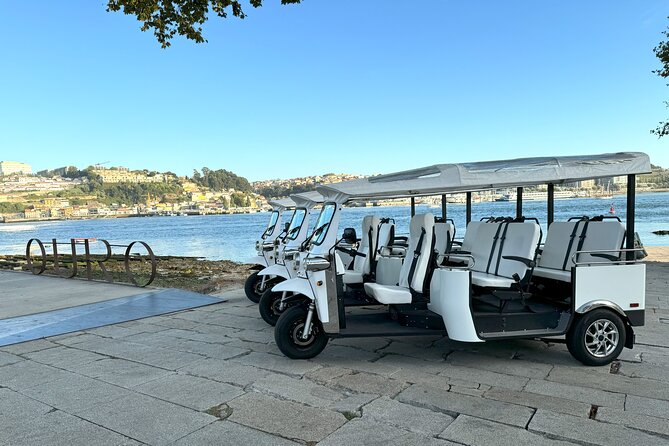
Also note the group setup: each tuk-tuk can handle 2, 3, or 4 adults (up to 75 kg each). If you’re in a larger group, you’ll likely ride in multiple vehicles while still sharing the same general stops at the same time.
The route: what each stop is really about (and what to do)
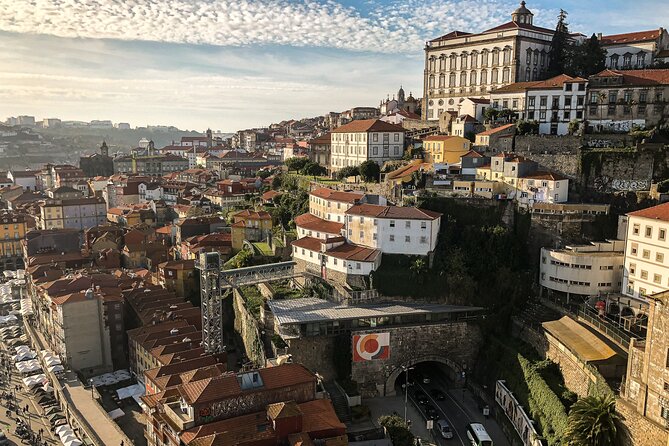
Below is the “mental map” I’d use if I were taking this tour. Porto’s icons can blur together unless you know what each one is trying to show you.
Rather go at your own pace? More private guides

Start near theatre history and a Romanesque boundary
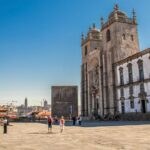
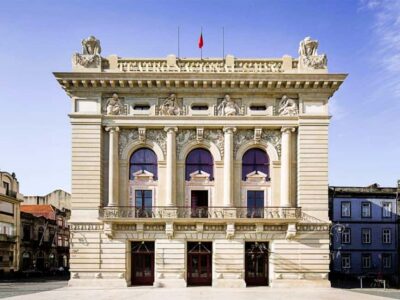
You begin around a major theatre building built in 1910 on older ruins (a theatre destroyed by fire in 1908). The façade references early-20th-century French influence in its renovation style, and the building’s design connects into the broader theatre ecosystem of central Porto. It’s the kind of stop that works best when your guide points out the symbolism and the building’s purpose—not just its looks.
Then you move to a Romanesque wall from the 12th century, which helps explain Porto’s older urban shape. Even if you don’t walk far, this is a useful “why the city feels the way it does” moment: Porto didn’t grow evenly. It expanded and redefined administrative boundaries over time.
Serra do Pilar: the terrace view that sells Porto
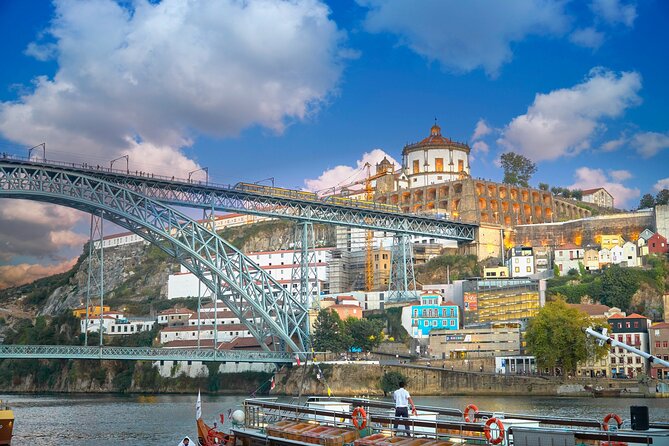
This is one of the biggest payoff stops. Mosteiro da Serra do Pilar began in 1538 and took until about 1670 to finish. It started for Augustinian friars, was affected during the 1832–1834 Civil War, and later benefited from recovery efforts led by the Royal Brotherhood of Lady of the Pilar and later groups that helped restore it.
What you’re there for:
- The circular church plan with the dome and surrounding balcony
- The cloister with 36 Ionic columns (a rare example in Portugal)
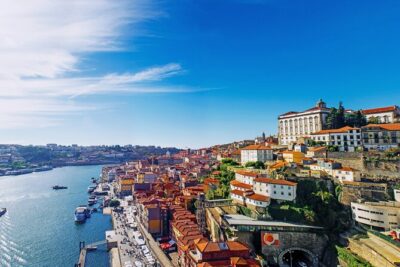
- The terrace perspective: you can see the riverside stretching through Porto and out toward Gaia and the Arrábida Bridge, plus the historic center and the Dom Luís I bridge line.
If you want the one “wow” viewpoint that justifies the tuk-tuk, this is it. Spend the full time provided if you can—don’t rush your eyes. Watch how the river bends and how the bridges frame the city.
Dom Luís I bridge: Eiffel’s disciple and two iron decks
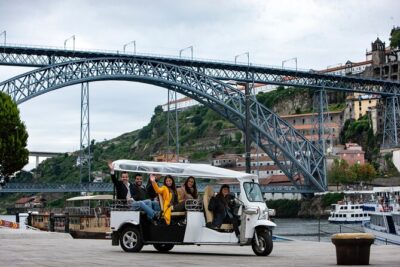
Next comes Dom Luís I bridge, planned by Teófilo Seyrig, a disciple of Eiffel. It was inaugurated in 1886 and uses two overlapping iron decks—an engineering flex and also a practical city feature. The bridge is about 395 meters long and 8 meters wide, and the forged-iron arch is still described as the world’s biggest of its kind.
Here’s the angle to listen for: the upper deck carries Metro of Porto, linking areas around Porto’s cathedral with parts of Vila Nova de Gaia. So when you look at the bridge, you’re not only seeing a monument—you’re seeing something still doing real work every day.
Igreja de São Francisco: Gothic bones plus Baroque gold
Igreja de São Francisco started in the 14th century and is one of Porto’s key Gothic monuments. But what draws most people is the gilded interior from the 17th and 18th centuries, which earned it the nickname Church of Gold in historical descriptions.
Two details to watch for:
- The Tree of Jesse
- The catacombs (if you choose to go inside and your time allows)
This stop works best if your guide explains the layers—Gothic structure with Baroque decoration—because Porto often feels like it’s stacked by centuries, not replaced.
Palácio da Bolsa and the Arabian Room idea
At Palácio da Bolsa (the Stock Exchange Palace), you’re looking at a neoclassical building finished in 1842. Its most famous moment is the Arabian Room, which signals how Porto’s wealth and international connections shaped interior design.
A useful way to think about this stop: it’s not only architecture. It’s also about how Porto’s commercial identity translated into elegant public spaces. The palace is still used for cultural and conference events, so it isn’t just a dead museum.
Praça near the Infante D. Henrique monument
You stop in the square surrounded by Mercado Ferreira Borges and Palácio da Bolsa. Underground parking sits below, but the main story is the Monument to Infante D. Henrique. The monument was built between 1894 and 1900 to mark the 5th centenary of his death, celebrating Portuguese navigation and faith.
If your guide is good, this becomes a quick history checkpoint: why Porto’s identity is tied to maritime ambition.
Jardins do Palácio de Cristal: the city’s “slow down” spell
Then you get the garden break at Jardins do Palácio de Cristal. It’s built like a mosaic of small gardens connected by paths, with fountains, sculptures, and trees like giant magnolias and olive trees. Views are part of the design: you look back toward the city and out toward the Rio Douro.
This is the stop where you’ll feel the value of having a guide choose your time for you. Without a plan, most visitors hit gardens too late, when light is poor or they’re too tired to enjoy them.
Mercado-to-entertainment: the iron architecture moment
Next is an iron-built market from 1885, created to replace an older Ribeira market. It was used briefly as a market before shifting functions, and today it’s known for entertainment—Hard Club is the headline name here.
Even if you don’t go in, it’s worth pausing outside because it shows Porto’s industrial-era creativity. Porto isn’t just churches and tiles. It has steel and reinvention too.
Alfândega Nova: museum building with two-faced design
At Alfândega Nova do Porto, you’ll notice the neoclassical design with facades facing both the Douro river and the city. The building’s structural plan used iron along with stone, brick, or wood depending on each area’s purpose.
In 1987, the building was set up for the future Museum of Transport and Communications, with restoration and adaptation associated with architect Eduardo Souto Moura. The space also functions as a congress center.
If you’re the kind of traveler who likes buildings that explain how cities worked, this one can be surprisingly satisfying—even on a short stop.
Igreja dos Carmelitas: a rococo altarpiece clue
Igreja dos Carmelitas dates to the 17th century, but its classical façade is from the 1850s. The project is attributed to Nicolau Nasoni, and the altarpiece is described in Porto rococo style as a revolutionary piece. This is also a national monument.
If you only peek for a minute, focus on the contrast between the façade’s classical look and the interior’s decorative story.
Cordoaria Garden (Jardim de João Chagas): ropes, statues, and 200 years
This stop often gets overlooked, but it’s a great “Porto is more than postcards” pause. Jardim de João Chagas, better known as Cordoaria Garden, connects to the long rope-making presence—rope makers stayed here for about 200 years.
The municipality turned Praça da Cordoaria into a public area in 1865/1866, designed by German landscaper Emile David. You’ll also see statues of Ramalho Ortigão and António Nobre, plus sculptures by Juan Muñoz from 2001 (including O rapto de Ganímedes). In the Porto 2001 cultural year, the garden got remodelled.
This is a good stop for breathing room and for letting the city’s smaller details sink in.
Torre dos Clérigos and Igreja do Carmo: baroque height and azulejo detail
You reach Torre dos Clérigos for the tall bell tower that can be seen from various parts of Porto. This is baroque, and it’s one of the city’s most recognizable symbols.
Then you move toward Igreja do Carmo, a rococo standout from the late 1700s. The lateral façade was covered with tiles (azulejos) in 1912, with drawings by Silvestre Silvestri. These tile stories connect to Our Lady devotion.
One practical note: both these stops indicate tickets may not be included. If you want to go in, do that decisively rather than spending your short time deciding.
Fonte dos Leões: a French water company’s copy
Fonte dos Leões is a 19th-century fountain built by the French company Compagnie Générale des Eaux pour l’Etranger, cast by the Val d’Osne foundry in France. It’s described as a copy of a fountain from the Town Hall Square of Leicester, England.
It’s a quick stop, but it gives you a nice reminder: Porto’s culture wasn’t built in isolation. Money, design, and engineering trends traveled.
Antiga Cadeia da Relação: prison geometry turned photo center
At Antiga Cadeia da Relação, you get an architectural story with real human weight. The granite building dates to 1582, rebuilt in 1767 in a neo-classical style by architect Eugénio dos Santos. The initiative came from João de Almada e Melo and was financed by the Companhia Geral das Vinhas do Alto Douro.
Look for the geometric pattern: 103 windows across the building. It’s polygonal with four façades, and the entrances reflect its past functions—court sector access one side, and direct passage for prisoners on the other. Notable people were held here, including writer Camilo Castelo Branco and the famous outlaw Zé do Telhado.
Today, it’s restored and used as the Portuguese Centre for Photography (restoration work was guided by Eduardo Souto de Moura and Humberto Vieira between 1999 and 2002). If you’re into modern re-use of older buildings, this stop can hit harder than expected.
Livraria Lello: Art Nouveau façade and the red-staircase vibe
Finally, you reach Livraria Lello, a library building inaugurated in 1906. The outside is Art Nouveau with neo-Gothic details, and inside you’ll find painted plaster that imitates wood, plus a dramatic staircase tied to reinforced concrete innovation. A large stained-glass skylight carries the monogram and motto: Decus in Labore.
This is the kind of stop where timing matters. Your time window is short, and tickets may not be included. If this is a must-see for you, decide beforehand: do you want a quick look from the exterior, or do you plan to go inside?
Guide quality is the real product: the best tours feel custom
Most of the praise you’ll see isn’t about the vehicles. It’s about the people driving and explaining. Guides such as Ana, Gabi, Fabio, Bernardo, Rafael/Rafaela, and Gonçalo have been praised for clear English, photo help, good pacing, and tailoring.
Here’s what to look for, and how to get it:
- Ask your guide early what you want most: river views, churches, or neighborhood character.
- When you stop, ask one specific question before you walk away. That’s how you turn a 5-minute pause into real understanding.
- If you care about wine, ask when it’s happening so you can time it with the rest of the route.
There are also a few red flags worth knowing in advance. Some past bookings reported a driver arriving late, feeling rushed, or having safety concerns (including one mention of speeding and another about smoking). No tour is perfect, and traffic in Porto can be chaotic, but you should feel comfortable taking action: ask your guide to slow down if you don’t feel safe, and speak up immediately if something feels off.
Also be aware of a practical limitation: the tuk-tuk canopy can make views more obstructed, especially in cloudy rain. If you’re visiting in a season with frequent grey skies, bring a light rain layer and plan to look when you’re stepping out.
Who should book this Porto half-day tuk-tuk tour
I’d book this if:
- You want a strong first-day orientation to Porto and Gaia
- You like short walking breaks with lots of “look up and notice” moments
- Hills make you tired, and you want to see more without exhausting your legs
- You care about guided explanations, not just moving from landmark to landmark
I might skip it if:
- You plan to spend a lot of time inside multiple churches and attractions. This is built for quick, high-impact stops.
- You’re very sensitive to timing shifts. Some experiences can run shorter or feel compressed when traffic and route conditions stack up.
- You’re a “quiet on my own” type and prefer self-guided time without stopping for commentary.
Should you book it?
Yes, I think you should—if you treat it as a guided “fast orientation” plus a few key moments you’ll remember, especially the Serra do Pilar viewpoint and the bridge-and-river framing.
Before you go, do two simple things:
- Pick your priorities (views, churches, architecture, food/wine) and tell your guide early.
- Be realistic about short stop times: if Livraria Lello, Torre dos Clérigos, or Igreja do Carmo are must-do interiors for you, decide on the spot whether to queue or do an exterior-first plan.
If you land with a strong guide—like the ones named repeatedly in standout experiences—you’ll leave Porto with that rare combo: lots of sights covered, plus actual context for what you saw.
FAQ
How long is the Porto half-day private tuk-tuk tour?
It runs for about 3 hours 30 minutes.
How many people can ride in one tuk-tuk?
Each tuk-tuk can carry 2, 3, or 4 adults (up to 75 kg per person). Larger groups may use multiple vehicles.
Is the tour private?
Yes. It’s a private tour, limited to your group or family.
What language is the tour offered in?
The tour includes live commentary and is offered in English.
Is wine tasting included?
Wine tasting is listed as included in the experience.
Are tickets included for all attractions?
Not all stops include admission. Torre dos Clérigos, Igreja do Carmo, and Livraria Lello are marked as admission not included, while several other stops are free.
Where does the tour start?
The meeting point is R. de Augusto Rosa 180, 4000-528 Porto, Portugal, and the tour ends back there.
What’s the weather rule?
This experience requires good weather. If it’s canceled due to poor weather, you’ll be offered a different date or a full refund.
More Tour Reviews in Porto



Private Porto Tours to Compare

Tuk-Tuk Runs Through the Hills

Fresh in the Porto notebook

Porto Tuk-Tuk Tours, compared.
 ★ 4.5Guided Tour by Tuk-Tuk & Optional Douro River CruiseFrom $205,980 reviews
 ★ 4.5Discover Porto’s Highlights on a 2-Hour Private Electric Tuk TukFrom $481,860 reviews
 ★ 4.6Guided Tuk Tuk TourFrom $411,390 reviews
 ★ 4.5Historic Porto by Private Electric Tuk Tuk to Top LandmarksFrom $42735 reviews
 ★ 4.5Porto Guided Tour to the Historical Center on a Tuk TukFrom $42418 reviews
 ★ 4.8Private Sightseeing Tour by Electric Tuk TukFrom $47305 reviews
 ★ 4.7Oporto Tuk-Tuk Tour: Fast, Fun & Flexible – 1H to Full Day!From $88280 reviews
 ★ 4.5Historic Center Tuk-Tuk TourFrom $21244 reviews
Browse the lists this tour appears in